Blog · AI agents and workflows
AI Voice Receptionist for Appointment Businesses: How It Works and What to Check
How an AI receptionist answers calls, books into your calendar and hands off to a person, plus the checks, test calls and launch metrics to get right first.
By Dijae Dadula · November 4, 2026 · 9 min read
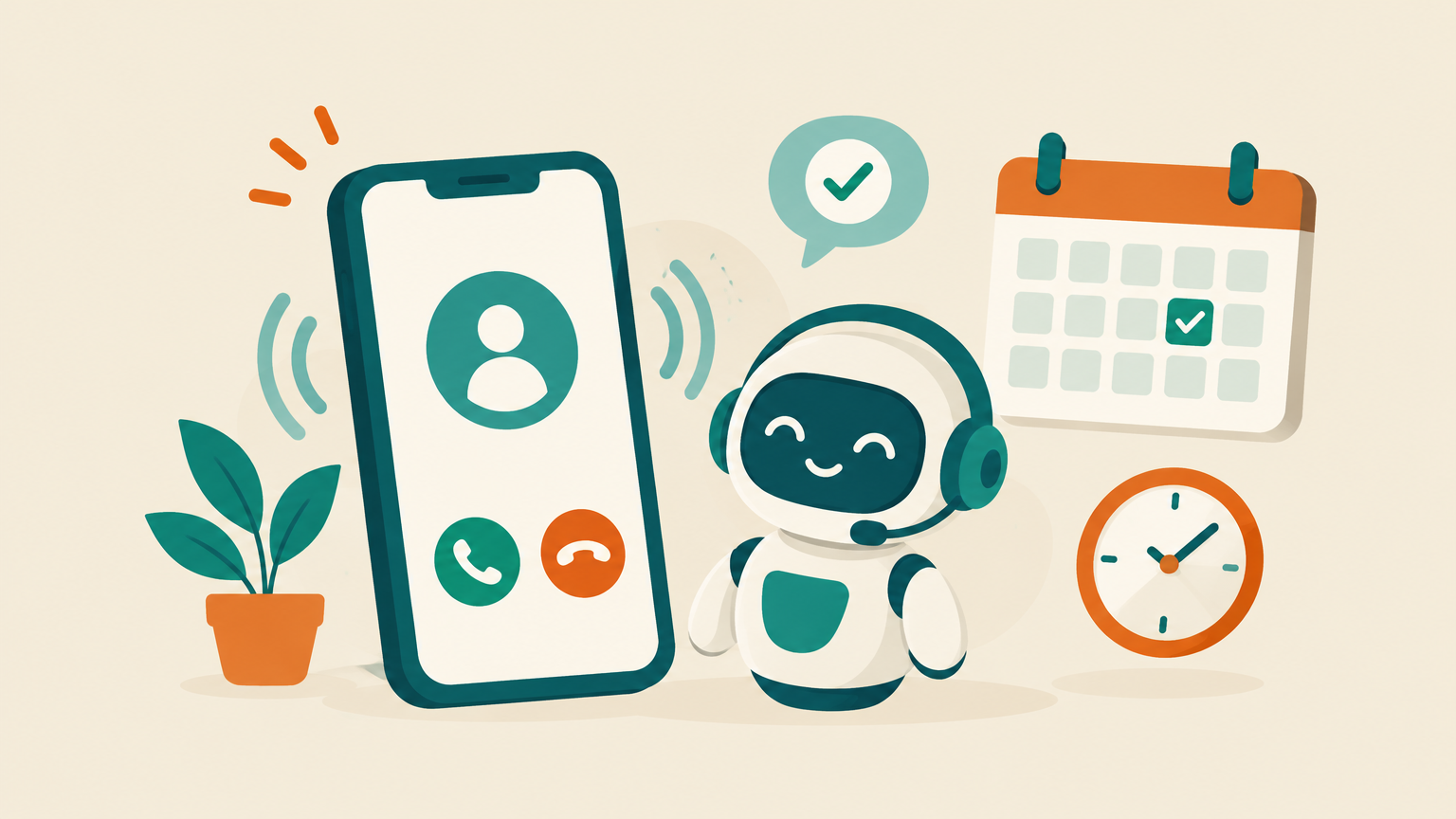
Appointment businesses lose calls at the worst possible moments: while the front desk is with a patient, while the stylist has wet hair in her hands, after hours, at lunch. A caller who reaches voicemail often just calls the next business on the list. An AI voice receptionist answers every one of those calls, books the slot into your calendar and hands the difficult ones to a person.
This guide is for clinics, salons, spas, dental and wellness practices, repair and home services, and agencies that set these systems up for clients. It explains how a voice receptionist works, how to set one up, what to check before it talks to a real caller, and how to know it is working.
What you will get
- The five parts of every AI voice receptionist, in plain English.
- A setup path with the settings that matter most for booking.
- A pre-launch checklist and a 10-call test script you can copy.
- The launch metrics to review every week.
1. What an AI voice receptionist does (and does not do)
An AI voice receptionist is an AI agent on a phone line. It listens, understands what the caller wants, answers from your business knowledge and takes action in your tools: it checks the calendar, books or moves an appointment, sends a confirmation and transfers the call when a person is needed.
| Good jobs for it | Keep with a person |
|---|---|
| Booking, rescheduling and cancelling appointments | Medical, legal or financial advice |
| Hours, location, parking, prices from your price list | Complaints and refunds |
| After-hours and lunch-time calls | Anything that needs judgment or an exception |
| Taking a clear message with a callback time | Callers who ask for a person |
The receptionist should be honest about what it is. Callers accept an AI that books quickly and transfers smoothly. They do not accept one that pretends to be human and then gets stuck.
2. How a call flows
Every voice receptionist, whatever the platform, is built from the same five parts: a phone number, speech-to-text that turns the caller's voice into text, an AI agent that decides what to do, tools it can use (calendar, CRM, SMS) and a voice that speaks the reply. The quality of the call depends on the weakest of the five.
Two parts decide most of the caller's experience. The first is speed: a long pause after the caller stops talking feels broken on a phone, even when the answer is right. The second is the transfer: when the agent hands the call to a person, the caller should hear what is happening, and the person picking up should get a short summary so the caller does not repeat everything. Voice platforms support this. ElevenLabs agents, for example, can transfer a call to a phone number with one message read to the caller and a separate briefing for the person who answers. For reference, check the documentation here.
3. Setting it up
For appointment businesses I recommend PayMeGPT, because the phone line, the AI agent, the knowledge, the calendar and the follow-up flows live in one place. These are the settings that matter, checked in PayMeGPT on November 4, 2026:
- 1Build the agent first. Write its instructions, add your services, prices, policies and FAQ as knowledge, and test it in chat before it ever takes a call. The instruction structure is in how to write AI agent instructions.
- 2Connect a phone number. A Twilio number is bound to the agent so it answers inbound calls. The phone voice is its own setting, separate from the web chat voice, with OpenAI, xAI (Grok) or ElevenLabs voices to choose from.
- 3Connect the calendar. Booking writes into a connected Google Calendar (or a native PayMeGPT calendar). Set the appointment lengths, the bookable hours and days, the time zone, a buffer between bookings and the minimum notice. Add your other calendars as conflict calendars so the agent never offers a time when you are already busy.
- 4Write the transfer and message rules. Name exactly when the agent transfers, who it transfers to, and what it does when nobody answers: take a message and say when a person will call back.
- 5Add the follow-up. A confirmation by SMS or email after every booking, and a reminder before the appointment, run as flows on the same contact record.
I could not read PayMeGPT's public changelog from here today, so check it for the newest voice features before you build. For reference, check the changelog here, and the walkthroughs on the PayMeGPT YouTube channel.
A voice agent should do one of three things on every call: book, transfer or take a clear message with a callback time. A call that ends with none of the three is a lost customer.
4. What to check before launch
Most voice agent failures are not about the AI. They come from settings nobody tested: a time zone, a buffer, a transfer number that rings a phone nobody carries.
| Check | Why it matters | How to test it |
|---|---|---|
| Booking accuracy | A wrong slot is worse than no booking | Book, move and cancel; confirm each change in the calendar |
| Time zone and hours | Callers get offered slots you are closed | Ask for the earliest and latest slot, and a weekend slot |
| Conflict calendars | Double-booking with your other commitments | Block a time in another calendar and try to book it |
| Response speed | Long pauses make callers talk over the agent or hang up | Listen to test calls for gaps after the caller stops speaking |
| Transfer | The caller must reach a person who knows why they called | Ask for a person during business hours and after hours |
| Knowledge | Wrong prices or policies on a call are hard to take back | Ask about every service and price on your list |
| Disclosure | Callers should know they are speaking to an AI assistant | Check the first sentence of every call |
| Recording and data | Recordings and transcripts are personal data | Confirm what is recorded, who can see it and how long it is kept |
Answering calls and making them are treated differently. In the United States, the FCC ruled in February 2024 that AI-generated voices count as “artificial” voices under the Telephone Consumer Protection Act, so outbound AI calls need the called person's prior express consent unless an exemption applies. For reference, check the summary here. In the Philippines, call recordings and caller details fall under the Data Privacy Act; the basics are in the Data Privacy Act guide for chatbots.
5. The 10-call test script
Run these ten calls yourself, from a phone that is not on your staff list, before the number goes live. Write down what happened on each one.
VOICE RECEPTIONIST TEST SCRIPT
1. Book the next available slot for your most common service.
2. Reschedule that booking to another day.
3. Cancel it.
4. Ask the price of a service that is on your price list.
5. Ask about something that is NOT in the knowledge.
6. Ask for a person during business hours.
7. Ask for a person after hours.
8. Play an upset caller with a complaint.
9. Call from a noisy place and speak fast.
10. Stay silent for 10 seconds, then hang up.

Pass when:
- Calls 1-3 match the calendar exactly (date, time, length, time zone).
- Call 4 gives the price on your list; call 5 says it will check, not a guess.
- Calls 6 and 8 reach a person, or end with a message and a callback time.
- Call 7 takes a message and states the callback time.
- Calls 9-10 end politely, with no booking made by mistake.
The same method, applied to chat, is in how to test an AI chatbot. The rules for when to hand off are in the handoff playbook.
6. Metrics after launch
Review these every week for the first month, then every month. Listen to a sample of real calls each time; the numbers tell you where to look, the recordings tell you why.
| Metric | What it tells you |
|---|---|
| Answered call rate | Share of calls the line picked up, including after hours |
| Booking completion rate | Share of booking calls that ended with a confirmed appointment |
| Wrong-booking rate | Bookings staff had to fix; aim for zero |
| Transfer rate and transfer success | How often the agent hands off, and how often a person actually picks up |
| No-outcome calls | Calls that ended without a booking, transfer or message |
| No-show rate | Whether confirmations and reminders are working |
The weekly review routine that keeps an agent accurate after launch is in AI agent monitoring after launch.
An honest limitation: voice is harder than chat. Heavy accents, background noise, poor signal and callers who talk over the agent still cause misunderstandings, and phone numbers and call costs differ by country. Start with booking and simple questions, keep a person reachable, and widen the agent's job only after the test calls and the weekly numbers say it is ready.
Frequently asked questions
What is an AI voice receptionist?
It is an AI agent that answers your business phone line. It understands what the caller needs, answers from your business information, books or changes appointments in your calendar and transfers the call to a person when needed.
Can an AI receptionist book appointments directly into my calendar?
Yes. Voice agents connected to a calendar, such as Google Calendar, can check availability and book, reschedule or cancel. Set the appointment lengths, hours, time zone, buffer and conflict calendars before launch, and test every change.
Should an AI receptionist tell callers it is an AI?
Yes. Say it in the first sentence. Callers accept an AI assistant that books quickly and transfers smoothly, and disclosure avoids the trust problem of a bot that pretends to be human.
Is it legal to make outbound calls with an AI voice?
In the United States, the FCC ruled in February 2024 that AI-generated voices are artificial voices under the TCPA, so outbound calls need prior express consent unless an exemption applies. Check the rules in each country you call, and get legal advice for outbound campaigns.
Put a receptionist on your phone line
Want a voice receptionist set up with your services, calendar, transfer rules and test calls? Book a free AI Automation Blueprint call.
Prefer to learn it step by step? Join the free weekly newsletter.
References
- ElevenLabs documentation: Transfer to number (conference, blind and SIP REFER transfers; caller and operator messages). Accessed November 2026.
- Cooley: FCC: AI-generated robocalls illegal under the TCPA, February 15, 2024.
- PayMeGPT changelog. Could not be read from this workspace on November 4, 2026; check for the newest voice features.
- PayMeGPT YouTube channel (walkthroughs).
Keep reading
Get one practical idea like this every week
Join the free newsletter on AI agents, automation and turning your skills into income. Prefer video? Watch the walkthroughs on YouTube.
Want a system like this built for your business? Book a free AI Automation Blueprint call, or see the done-for-you services at my consultancy, IRD Digital Marketing Services.
DIJAE DADULA
Dijae Dadula · AI automation and systems specialist · Cavite, Philippines · Founder of IRD Digital Marketing Services
Home · Blog · Book a call · Newsletter · YouTube · Threads · Transparency
Some links on this site are affiliate links. If you buy through them, I may earn a commission at no extra cost to you.
© 2026 Dijae Dadula. All rights reserved.
