Blog · CRM and automation that sells
How Much Does an AI Agent Save? The 5 Chatbot ROI Metrics That Matter
Message counts do not pay the bills. These five metrics, one formula and a worked example show whether your AI agent is earning its keep.
By Dijae Dadula · October 14, 2026 · 7 min read
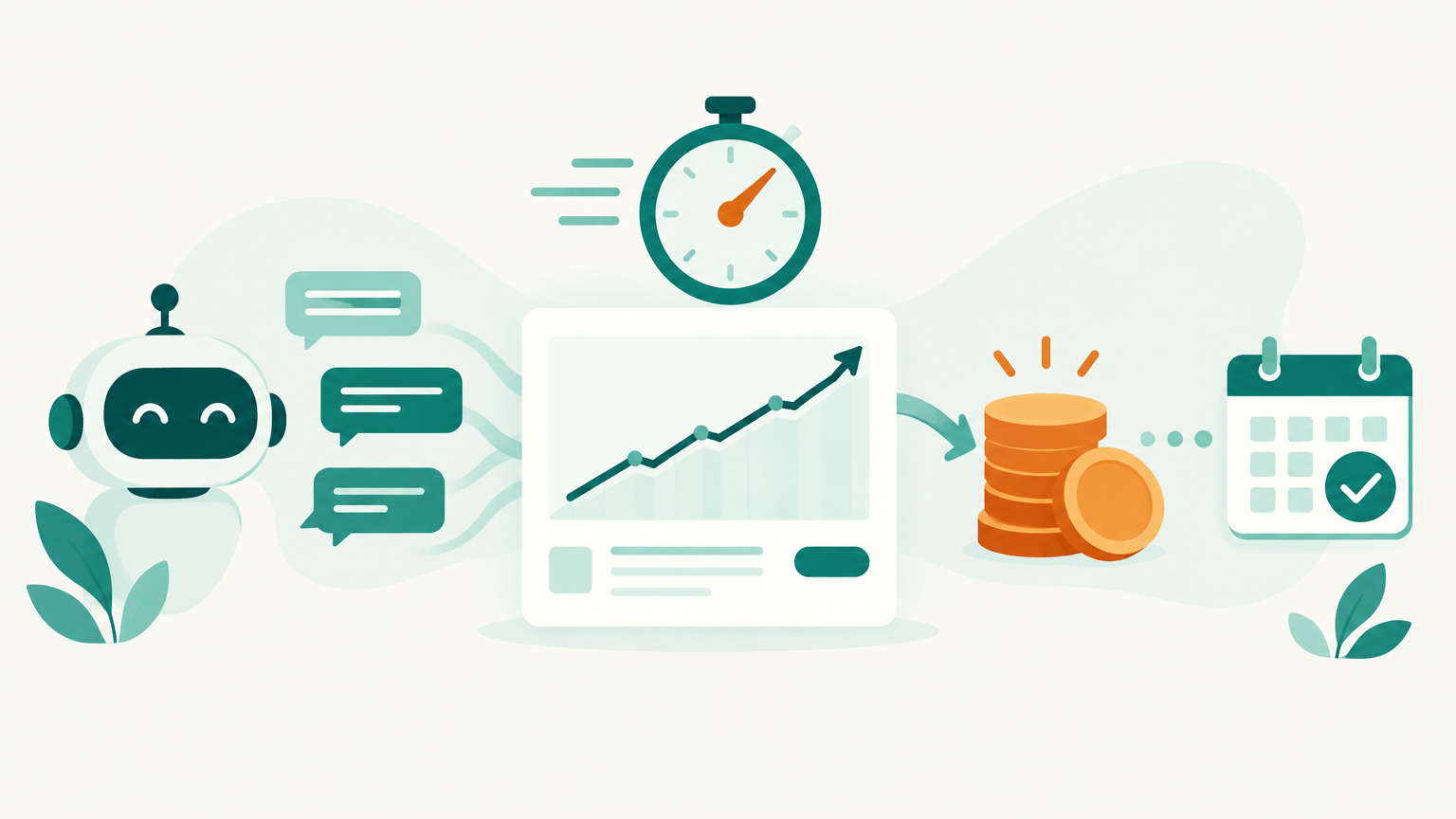
“Is the chatbot working?” is the wrong question. A chatbot can answer thousands of messages and still lose money, and a small one that handles a few hundred conversations can pay for itself many times over. The difference is whether you measure what the business cares about: faster answers, more sales, less staff time and lower cost per customer.
This guide gives you five metrics that show whether an AI agent is earning its keep, the formula to put them into one monthly number, and a worked example you can copy into a spreadsheet.
The five metrics
- Speed to first reply: how fast a customer gets a useful answer.
- Containment rate: the share of conversations the AI finishes without a person.
- Conversion rate: the share of conversations that end in an order or booking.
- Cost per conversation: what each AI-handled chat costs you.
- Handoff quality: whether the chats passed to people arrive ready to close.
1. Speed to first reply
Speed is where an AI agent pays off first, because interest fades fast. A widely cited study published in Harvard Business Review in 2011 found that companies that contacted online leads within an hour were nearly seven times as likely to qualify the lead as those that waited even one more hour, and more than 60 times as likely as companies that waited 24 hours or longer.
How to measure it: the median time between a customer's first message and the first reply that answers their question. An auto-greeting that says “we'll get back to you” does not count. Track it by hour of day, because the gap usually hides in evenings and weekends.
Good sign: a first useful reply within a minute at any hour.
2. Containment rate
Containment is the share of conversations the AI handles from start to finish without a person stepping in. It is the metric that shows how much staff time the agent saves.
Containment rate = conversations completed by AI
                   / total AI conversations
A high number is not automatically good. If the AI “contains” an angry customer who needed a person, that is a failure counted as a success. Read a sample of contained conversations every week and check that they were resolved, not abandoned.
3. Conversion rate
Conversion is the share of conversations that end in the outcome you defined as the agent's goal: an order, a booking, a qualified lead or a call scheduled.
Conversion rate = conversations that reached the goal
                  / total conversations
Compare it with the conversion rate of conversations handled only by people over the same period. If the AI converts far less, look at where conversations stop. Most drop-offs happen at one question that is too early, too long or unclear.
4. Cost per conversation
AI agents bill by usage, so cost per conversation is measurable to the cent. In Botcake AI, every Preview reply shows its input tokens, output tokens and estimated cost. In a test on GPT-4.1 mini, one reply cost an estimated $0.0013. The walkthrough is in the Botcake AI + Pancake setup guide.
Cost per conversation = (AI usage + platform subscriptions
                         + maintenance time cost)
                        / total AI conversations
Include the time someone spends reviewing conversations and updating instructions. That is a real cost, and leaving it out makes every chatbot look cheaper than it is.
5. Handoff quality
The conversations the AI passes to your team should arrive ready to close. Measure two things:
- Handoff rate: the share of conversations passed to a person. Too low can mean the AI keeps customers it should release. Too high means it is not doing its job.
- Handoff completeness: the share of handed-off conversations where your team did not need to ask the customer again for details the AI should have collected.
6. Put it into one ROI number
Once you have the five metrics, combine them into one monthly figure your business can act on.
Monthly value  = (staff hours saved x hourly cost)
               + (extra sales from AI x average profit per sale)

Monthly cost   = AI usage + subscriptions + maintenance time

Monthly ROI    = (Monthly value - Monthly cost) / Monthly cost
Here is a worked example for an online shop. Every figure is an illustrative assumption, not a benchmark. Replace each one with your own numbers.
| Input (example) | Value | How it is calculated |
|---|---|---|
| AI conversations per month | 3,000 | From your platform's statistics |
| AI replies per conversation | 6 | Average from a sample |
| Cost per AI reply | $0.0013 | Botcake AI test reply on GPT-4.1 mini |
| AI usage cost | $23.40 | 3,000 × 6 × $0.0013 |
| Containment rate | 60% | 1,800 conversations finished by AI |
| Staff minutes per conversation | 5 | Measured before launch |
| Staff hours saved | 150 | 1,800 × 5 ÷ 60 |
| Staff hourly cost | $4 | Your actual cost |
| Value of time saved | $600 | 150 × $4 |
| Extra orders from after-hours replies | 40 | Orders started outside office hours |
| Average profit per order | $8 | Your margin, not your price |
| Value of extra sales | $320 | 40 × $8 |
| Subscriptions and maintenance | $150 | Platform plans plus review time |
| Monthly ROI | about 4.3x | ($920 − $173.40) ÷ $173.40, where $920 is total value and $173.40 is total cost |
The example shows a pattern worth knowing: AI usage is usually the smallest line. Staff time and missed sales are where the money is, so those are the numbers to measure carefully.
7. Set a baseline before you launch
ROI is a comparison, and you cannot compare without a “before”. Spend two weeks measuring your current inbox before switching the AI on:
- Median time to first reply, by hour of day.
- Conversations per week and minutes of staff time per conversation.
- Conversion rate from conversation to order or booking.
- The ten most common questions.
Then launch, and compare the same numbers monthly. An honest limitation: other changes, such as a new promo or ad campaign, also move these numbers. Note what else changed each month so you do not credit or blame the AI for something it did not do.
Frequently asked questions
What is a good containment rate for an AI chatbot?
It depends on what customers ask. Simple, repetitive questions allow high containment. Complex sales and complaints need people. Set your target from your own baseline and review contained conversations to confirm they were truly resolved.
How soon should a chatbot pay for itself?
Track it from the first month. If speed and staff time improve but sales do not, the instructions or the conversation steps usually need work, not the platform.
Which metric matters most?
For most businesses that sell through chat, speed to first reply and conversion rate. Speed keeps interested customers, and conversion shows whether the conversation turns them into buyers.
Where do I find these numbers?
Your chatbot platform's statistics give conversation counts and handoffs. Your inbox tool gives reply times. Your order system gives sales. Put them in one spreadsheet each month.
Want these metrics set up for you?
I design, test and measure AI agents for businesses, starting from the numbers above. Book a free AI Automation Blueprint call.
Tools used in the example: Botcake and Pancake (coupon CHAMP20 for 20% off all Pancake plans plus 30 days free for new Pancake customers or a new billing account). These are affiliate links.
References
- Oldroyd, J. B., McElheran, K. and Elkington, D. The Short Life of Online Sales Leads. Harvard Business Review, March 2011.
- Botcake AI + Pancake Setup Guide (message cost test), Dijae Dadula, October 2026.
Keep reading
Get one practical idea like this every week
Join the free newsletter on AI agents, automation and turning your skills into income. Prefer video? Watch the walkthroughs on YouTube.
Want a system like this built for your business? Book a free AI Automation Blueprint call, or see the done-for-you services at my consultancy, IRD Digital Marketing Services.
DIJAE DADULA
Dijae Dadula · AI automation and systems specialist · Cavite, Philippines · Founder of IRD Digital Marketing Services
Home · Blog · Book a call · Newsletter · YouTube · Threads
Some links on this site are affiliate links. If you buy through them, I may earn a commission at no extra cost to you.
© 2026 Dijae Dadula. All rights reserved.
