Blog · CRM and automation that sells
Email, Messenger, SMS or WhatsApp: Choosing the Right Channel for Automated Follow-Up
An executive brief on the four follow-up channels: the rules that decide when you can message, what each one costs, which messages belong where, and how to measure it.
By Dijae Dadula · November 10, 2026 · 7 min read
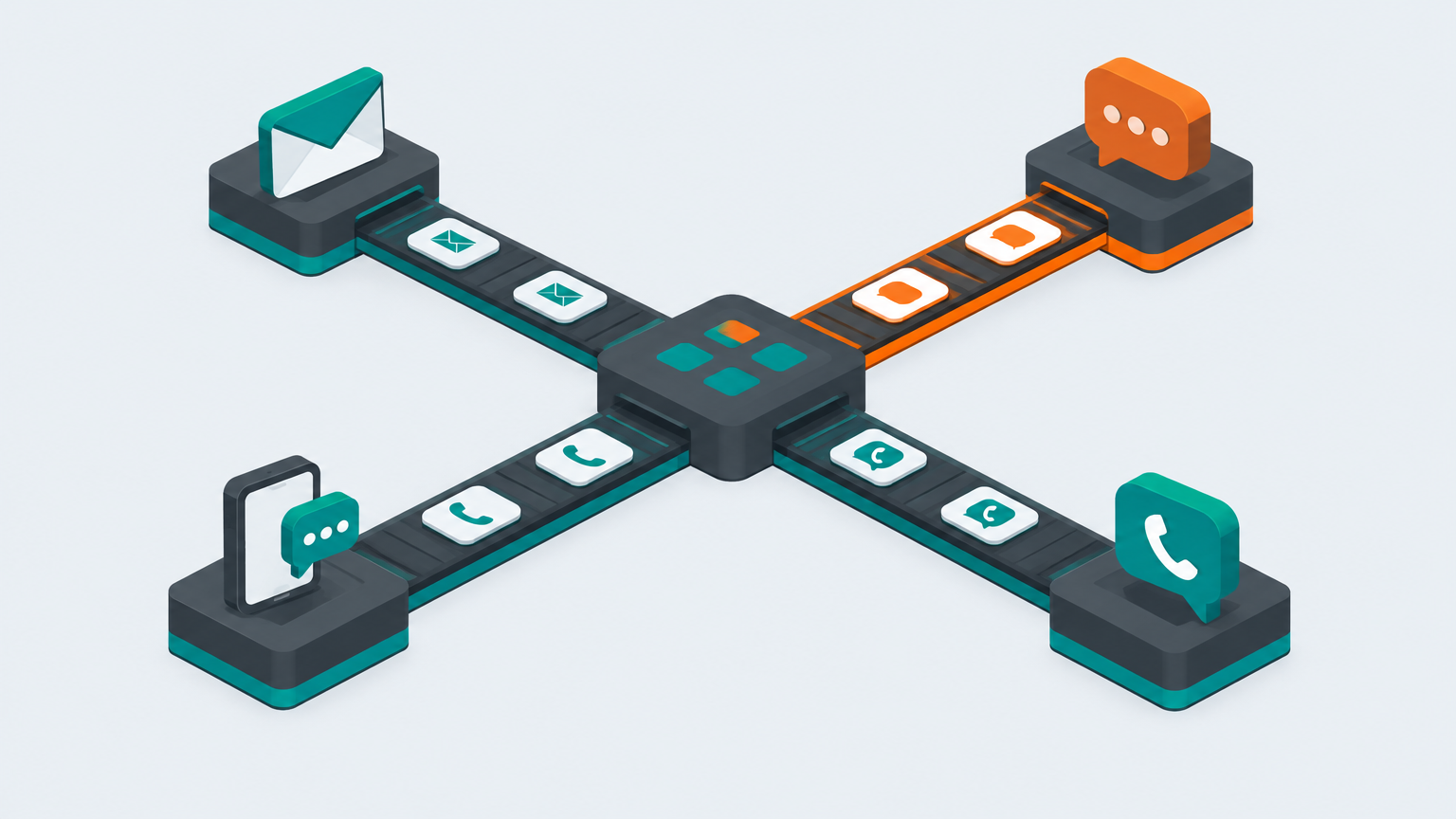
The 60-second brief
- No single channel wins. Each one has its own rule for when you are allowed to message, its own consent requirement and its own cost model.
- Messenger and WhatsApp are strongest inside the 24 hours after the customer last wrote. Email and SMS reach people later, but only with consent and proper sender setup.
- The best follow-up starts on the channel the customer chose, then moves to an owned channel, with permission, for the longer sequence.
Decision: reply where the conversation started, ask for permission to continue elsewhere, and match each message type to the channel built for it.
This brief is for business owners, marketers and the agencies that set up follow-up for them. It compares the four channels on the rules that matter, then gives a five-move plan for choosing and measuring.
Move 01 · Reply
Start where the customer started
Answer on the channel the customer used, while their window is open.
That is where they are waiting, and where your reply costs least.
Make the first reply instant and useful, then ask how they prefer to hear from you next.
A customer who messages your Facebook Page is already in Messenger. Moving them to email in the first reply adds friction for no gain. On Messenger, a business can message freely for 24 hours after the customer's last message, and up to 7 days when the conversation started from a Click-to-Messenger ad. WhatsApp works the same way: a 24-hour customer service window opens each time the customer writes. Inside those windows, follow-up is easy. After them, the rules tighten. The speed side is in lead response time.
Move 02 · Rules
Know each channel's rules before you automate
Each channel decides when you may message, with what consent, at what cost.
Breaking a rule gets messages blocked, filtered as spam or accounts restricted.
Write the rule for each channel into your automation before the first sequence goes live.
| Channel | When you can message | Permission and setup | Cost model |
|---|---|---|---|
| Messenger | Freely for 24 hours after the customer's last message (7 days after a Click-to-Messenger ad). After that, only approved utility templates, the human-agent tag, or paid marketing and sponsored messages | The customer starts the conversation; marketing messages need opt-in | Replies in the window are free; marketing and sponsored messages are paid |
| Freely for 24 hours after the customer writes. After that, approved templates only | Opt-in for business-initiated templates | Per message by category (marketing, utility, authentication) since July 1, 2025. From October 1, 2026, service messages beyond 1,000 a month and utility templates in the window are charged too | |
| Any time, with consent | Gmail requires SPF, DKIM and DMARC, one-click unsubscribe and a spam rate below 0.3% | Low per message; the cost is list care and deliverability | |
| SMS (US) | Any time, with consent and quiet-hours care | Business numbers must be registered for 10DLC; unregistered traffic is blocked since February 1, 2025 | Per message plus registration and carrier fees |
The Messenger detail, including the retired message tags and the newer utility and marketing messages, is in chatbot conversation design. For reference, check the Messenger documentation here. Rules and prices change often, especially on WhatsApp, so re-check them before every new build.
Move 03 · Match
Match the message to the channel
Decide channel by message type, not by habit.
A reminder belongs where it is seen in minutes; a guide belongs where it can be kept.
Map your five most common follow-up messages to a primary and a backup channel.
Use this as a starting map, then adjust for your market. The orange square marks the one place SMS clearly earns its cost: short, time-critical reminders to people who opted in.
Move 04 · Sequence
Build a cross-channel sequence, with permission
A follow-up plan that starts in chat and continues on an owned channel.
Chat windows close; a buyer who needs a week to decide still needs your follow-up.
Ask for email or phone consent inside the window, with a clear reason.
Keep the consent request honest and specific: “Can I email you the price list and check in on Thursday?” works better than a generic form. In the Philippines, record that consent; the steps are in the Data Privacy Act guide for chatbots. The follow-up messages themselves are in how to automate lead follow-up.
Follow up where the conversation lives. Move it to another channel only with the customer's permission and a reason they would agree with.
Move 05 · Measure
Measure each channel on what it costs to move a lead
Three numbers per channel, reviewed monthly.
A cheap channel that nobody reads is the most expensive one.
Tag every follow-up with its channel so the numbers separate cleanly.
Success metric: cost per booked call (or per order) by channel, next to reply rate and opt-out or block rate. Keep a channel when it books at a cost you accept and its opt-outs stay flat.
| Launch checklist for a new follow-up channel | |
|---|---|
| The channel's messaging window and consent rule are written into the automation | |
| Email: SPF, DKIM and DMARC pass; one-click unsubscribe works | |
| SMS (US): number registered for 10DLC; opt-out keywords honored | |
| WhatsApp: templates approved; cost per message category checked for your countries | |
| Any reply stops the sequence and alerts a person | |
| Every message is tagged by channel for reporting |
An honest limitation: this brief covers the general rules for Messenger, WhatsApp, Gmail and US SMS. It does not cover every country's SMS and consent law, and WhatsApp prices change by country and quarter. Check the current rules for your markets before you commit a budget.
Frequently asked questions
What is the best channel for customer follow-up?
The one the customer used first, for the first replies. For longer follow-up, email works for most businesses because it allows messages at any time with consent; SMS and WhatsApp suit short, time-critical reminders.
Can I follow up on Messenger after 24 hours?
Only in limited ways: approved utility messages for transactional updates, the human-agent tag for a person replying within 7 days, or paid marketing and sponsored messages. Promotional follow-up outside the window needs opt-in or ads.
Is WhatsApp follow-up free?
Not entirely. WhatsApp charges per message by category since July 1, 2025. From October 1, 2026, each business number gets 1,000 free service messages a month, and utility templates inside the 24-hour window are charged.
Do I need to register to send business SMS in the US?
Yes. Application-to-person texts from standard 10-digit numbers must be registered for 10DLC, and unregistered traffic has been blocked since February 1, 2025.
Plan your follow-up channels
Want instant replies in chat and a permission-based follow-up sequence set up for your business? Book a free AI Automation Blueprint call. Tools that fit this well: Botcake for Messenger and GoHighLevel for email and SMS sequences (affiliate links: I may earn a commission at no extra cost to you).
Prefer to learn it step by step? Join the free weekly newsletter.
References
- Meta: Messenger Platform, sending messages (24-hour standard messaging window and exceptions). Checked November 2026.
- Zoho: WhatsApp pricing changes, pay per message from July 1, 2025.
- respond.io: WhatsApp pricing change, October 1, 2026, and SleekFlow: WhatsApp Business API pricing.
- PPC Land: Google's requirements for bulk email senders to Gmail (effective February 1, 2024).
- FreePBX community: unregistered 10DLC traffic blocked from February 1, 2025.
Keep reading
Get one practical idea like this every week
Join the free newsletter on AI agents, automation and turning your skills into income. Prefer video? Watch the walkthroughs on YouTube.
Want a system like this built for your business? Book a free AI Automation Blueprint call, or see the done-for-you services at my consultancy, IRD Digital Marketing Services.
DIJAE DADULA
Dijae Dadula · AI automation and systems specialist · Cavite, Philippines · Founder of IRD Digital Marketing Services
Home · Blog · Book a call · Newsletter · YouTube · Threads · Transparency
Some links on this site are affiliate links. If you buy through them, I may earn a commission at no extra cost to you.
© 2026 Dijae Dadula. All rights reserved.
