Blog · AI agents and workflows
What Is Generative Engine Optimization (GEO)? How to Get Your Business Recommended by ChatGPT and AI Search
An executive brief on GEO: what it is, how AI assistants find and cite businesses, what the research says works, and how to measure it without chasing tricks.
By Dijae Dadula · November 15, 2026 · 10 min read
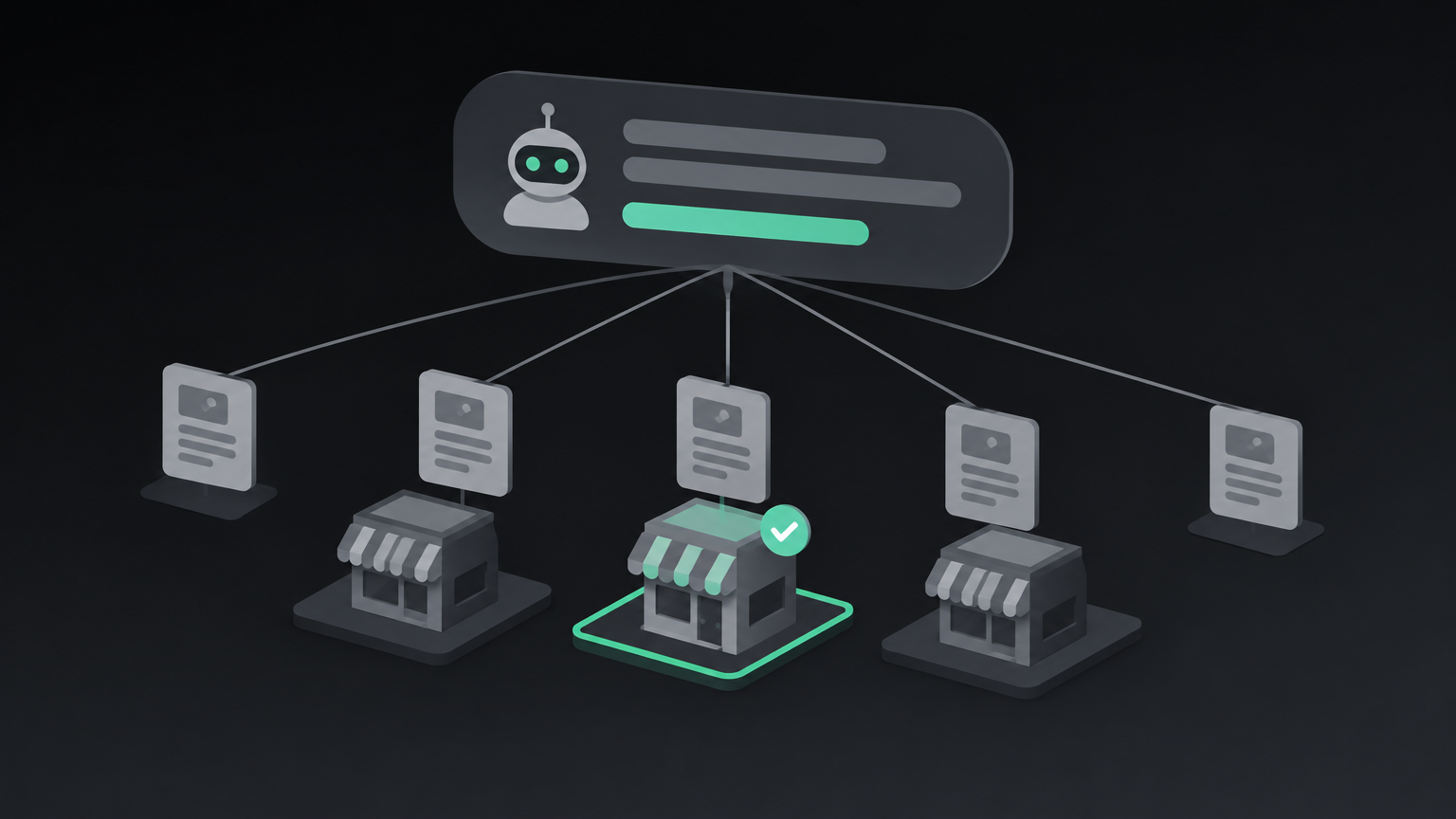
Generative engine optimization (GEO) is the work of making your business easy for AI assistants such as ChatGPT, Perplexity, Microsoft Copilot and Google's AI Overviews to find, understand and cite when someone asks for a recommendation. It builds on SEO: the assistant still has to reach your pages, trust them and quote them. Nobody can guarantee a mention, but you can make your business the clearest, best-sourced answer available.
The 60-second brief
- AI assistants answer by searching the web or their own index, reading a handful of sources and citing some of them. If your pages are blocked, thin or vague, you are not in the pool.
- The 2024 GEO research found that adding quotations, statistics and cited sources raised a page's visibility in AI answers, while keyword stuffing did worse than doing nothing.
- Google, OpenAI, Perplexity and Microsoft all describe the same basics: crawlable pages, clear structure, original expertise and accurate business listings. Two of them now report AI citations to site owners.
Decision: treat GEO as SEO plus clarity. Open your site to AI search crawlers, rewrite your key pages answer-first with sourced facts, keep your listings consistent, and measure mentions monthly.
This brief is for business owners, marketers and agencies who want their business named when a customer asks an AI assistant “who is the best ... near me?” or “which tool should I use for ...?”. It is the pillar of a GEO series on this blog: five moves, each with what to do and how to check it.
Move 01 · Define
What is GEO, and how is it different from SEO?
GEO aims for a mention or citation inside an AI answer, not only a blue link.
Customers increasingly ask an assistant for one shortlist instead of scanning ten results.
List the ten questions customers ask before they buy from you. Those are your GEO targets.
The term comes from a 2024 research paper by Pranjal Aggarwal and colleagues at IIT Delhi and Princeton University, presented at the ACM KDD conference. They define a generative engine as a system that retrieves sources and writes one synthesized answer with citations. SEO competes for a position on a results page. GEO competes for a place inside the answer itself.
The two overlap heavily. Google's own guidance, updated July 10, 2026, says optimizing for its AI features “is optimizing for the search experience, and thus still SEO.” Its AI Overviews and AI Mode draw on the same Search index and ranking systems, and they run several related searches at once (Google calls this query fan-out) to build an answer. So GEO is not a replacement for SEO. It is SEO with a sharper focus on being quotable, specific and trustworthy.
Move 02 · Access
Can ChatGPT, Perplexity and Google actually reach your website?
Each AI company runs named crawlers, and robots.txt decides which ones may read your site.
A page an assistant cannot fetch can still be named, but it is rarely quoted or linked.
Open yoursite.com/robots.txt and confirm the search crawlers below are not blocked.
The important distinction is between search crawlers, which decide whether you can appear and be linked in answers, and training crawlers, which collect content for future models. You can allow one and block the other.
| Crawler | Company | What it does | Block it? |
|---|---|---|---|
| OAI-SearchBot | OpenAI | Surfaces websites in ChatGPT's search features | No, if you want to appear in ChatGPT search |
| GPTBot | OpenAI | Collects content that may be used to train OpenAI's models | Your choice; it does not control search visibility |
| ChatGPT-User | OpenAI | Fetches a page when a user asks ChatGPT to; not an automatic crawler | Rarely useful to block |
| PerplexityBot | Perplexity | Surfaces and links websites in Perplexity results; not used for training foundation models | No, if you want to appear in Perplexity |
| Googlebot | Indexes pages for Search, which feeds AI Overviews and AI Mode | No; a page must be indexed and snippet-eligible |
OpenAI and Perplexity both say a robots.txt change can take about 24 hours to take effect. Google adds one more control: since its June 3, 2026 announcement, rolled out worldwide by August 31, 2026, Search Console has a single toggle to opt a site out of AI Overviews and AI Mode. Leave it on if you want to be recommended. For reference, check the OpenAI crawler documentation here and the Perplexity crawler documentation here.
Move 03 · Write
What kind of content do AI answers quote?
Specific, sourced, quotable statements beat keyword-heavy copy.
An assistant builds its answer from sentences it can lift and attribute with confidence.
Rewrite your top five pages so each opens with a two-sentence answer and backs it with facts and sources.
The GEO paper tested nine ways of rewriting a web page on its GEO-bench set of 10,000 queries and measured how much of each source made it into the generated answer, weighted by position. The results are a useful guide to what helps and what does not.
In practice, that translates into four habits for every important page:
- Answer first. Open with two or three sentences that answer the page's question and still make sense when quoted alone.
- Add facts with sources. Prices, service areas, hours, years in business, policies: state them plainly, with a date, and link the source when a claim comes from someone else.
- Quote real authorities. A short, attributed quote from a regulator, a standard or a recognised expert gives the assistant something it can cite.
- Use questions as headings. Phrase sections the way customers ask, and keep each section understandable on its own.
Google adds two warnings worth taking seriously. It says you do not need special AI text files, extra markup or Markdown versions to appear in its AI features, and that its Search ignores llms.txt files. It also says that spinning up a page for every variation of a question to manipulate AI answers breaks its scaled content abuse policy. For reference, check Google's optimization guide here. How your own AI agent uses the same kind of clear knowledge is covered in RAG for business knowledge.
Be the clearest, best-sourced answer to one question your customers actually ask. AI visibility follows clarity and evidence, never tricks.
Move 04 · Presence
Where else do AI assistants look for your business?
Your listings, reviews and mentions on other sites are sources too.
An answer that names three businesses often leans on third-party pages, not only the businesses' own sites.
Make your name, category, address, phone and one-line description identical everywhere you are listed.
Google's guide names Google Business Profile and Merchant Center as ways to improve visibility in its AI responses. For a local service business, the profile is often the first thing an AI answer draws on: categories, hours, service area, photos and reviews. Bing Places plays the same role for Microsoft's results. Beyond listings, assistants read directories, industry associations, news coverage and review sites.
| Source | What to fix first |
|---|---|
| Google Business Profile | Primary category, services, hours, service area, photos, reply to every review |
| Bing Places | Same details as Google, claimed and verified |
| Merchant Center (if you sell products) | Accurate product feed with prices and availability |
| Directories and associations | One consistent name, description and website link |
| Social and video profiles | The same one-line description, linking the matching page on your site |
Consistency matters because an assistant that finds three different descriptions of your business has less reason to trust any of them. This is also why customer experience shows up in AI answers: reviews are public text, and assistants read them. Fast, useful replies in chat help here too, which is covered in AI chatbots for small businesses.
Move 05 · Measure
How do you know whether AI assistants recommend your business?
Two official reports plus a fixed monthly prompt test.
AI answers vary by wording and session, so one screenshot proves nothing either way.
Pick ten customer questions, ask them in the same assistants every month, and log the result.
Two search companies now report AI visibility to site owners. Bing Webmaster Tools added an AI Performance report in public preview on February 10, 2026: it shows total citations, the average number of your pages cited and the grounding queries the AI used, across Microsoft Copilot, AI summaries in Bing and select partners. Google Search Console is rolling out data on impressions and which pages appear in its AI responses, by country. Both are free once your site is verified.
Success metric: mention rate across a fixed set of ten customer questions in ChatGPT, Perplexity, Google AI Mode and Copilot, checked monthly, alongside cited pages in Bing's AI Performance report. Watch the trend over three months, not a single result.
| GEO readiness checklist | |
|---|---|
| robots.txt allows OAI-SearchBot, PerplexityBot and Googlebot | |
| Google Search Console and Bing Webmaster Tools are verified, and the AI features toggle is on | |
| Top five pages open with a two-sentence answer and question-style headings | |
| Every claim on those pages has a date, a number where relevant, and a source | |
| Google Business Profile and Bing Places match your website word for word | |
| A monthly log of ten customer questions across four assistants exists |
An honest limitation: no one controls what an AI assistant says. Answers change with the wording of the question, the user's location and history, and each company's model updates. The GEO paper's figures come from controlled tests on its own benchmark, not from guaranteed results on live assistants, and Google says no third-party tool has access to its ranking or AI systems. Treat anyone who promises a guaranteed ChatGPT recommendation with caution.
Frequently asked questions
What does GEO stand for?
Generative engine optimization: improving how often and how prominently AI assistants such as ChatGPT, Perplexity, Copilot and Google's AI Overviews mention and cite your business or content in their answers.
Is GEO different from SEO?
It overlaps heavily. AI search features rely on search indexes and ranking systems, so SEO basics still apply. GEO adds a focus on being quotable: clear answers, sourced facts and consistent information across the web.
Do I need an llms.txt file to appear in AI answers?
Not for Google. Its guidance, updated July 10, 2026, says Google Search ignores llms.txt and that no special AI files or markup are needed to appear in its AI features.
Can I pay to be recommended by ChatGPT?
No one can buy or guarantee an organic recommendation inside an AI answer. Ads are a separate, labelled product. The reliable route is being reachable, clear, well-sourced and consistently listed.
How long does GEO take to work?
Crawler access changes can apply within about 24 hours, according to OpenAI and Perplexity. Content and listing improvements usually need several weeks of recrawling, so measure the trend over three months.
Get your business ready for AI search
The GEO series continues weekly: how assistants choose which businesses to recommend, GEO vs SEO, and how to write pages AI quotes. Join the free weekly newsletter to get each one.
Want your site, listings and chat set up so AI assistants and customers both get clear answers? Book a free AI Automation Blueprint call.
References
- Aggarwal, Murahari, Rajpurohit, Kalyan, Narasimhan and Deshpande: GEO: Generative Engine Optimization, KDD 2024 (GEO-bench, method results).
- Google Search Central: Optimizing your website for generative AI features on Google Search, updated July 10, 2026.
- Google Search Central: AI features and your website.
- Google: New opportunities, control and insights for website owners, June 3, 2026, updated August 31, 2026.
- OpenAI: Overview of OpenAI crawlers. Checked November 2026.
- Perplexity: Perplexity crawlers. Checked November 2026.
- Bing Webmaster Blog: Introducing AI Performance in Bing Webmaster Tools public preview, February 10, 2026.
Keep reading
Get one practical idea like this every week
Join the free newsletter on AI agents, automation and turning your skills into income. Prefer video? Watch the walkthroughs on YouTube.
Want a system like this built for your business? Book a free AI Automation Blueprint call, or see the done-for-you services at my consultancy, IRD Digital Marketing Services.
DIJAE DADULA
Dijae Dadula · AI automation and systems specialist · Cavite, Philippines · Founder of IRD Digital Marketing Services
Home · Blog · Book a call · Newsletter · YouTube · Threads · Transparency
Some links on this site are affiliate links. If you buy through them, I may earn a commission at no extra cost to you.
© 2026 Dijae Dadula. All rights reserved.
