Blog · AI agents and workflows
AI Chatbot Liability: What the Air Canada Ruling Means for Your Business
A website chatbot invented a refund rule and the airline had to pay. What the tribunal decided, why, and how to make sure your chatbot only promises what your business would.
By Dijae Dadula · November 13, 2026 · 8 min read
A customer asks your website chatbot whether a discount still applies after they have paid. The chatbot says yes, confidently, and even explains the steps. Your policy page says no. The customer books, follows the steps, and asks for the discount. Your team points to the policy page. The customer points to the chat transcript.
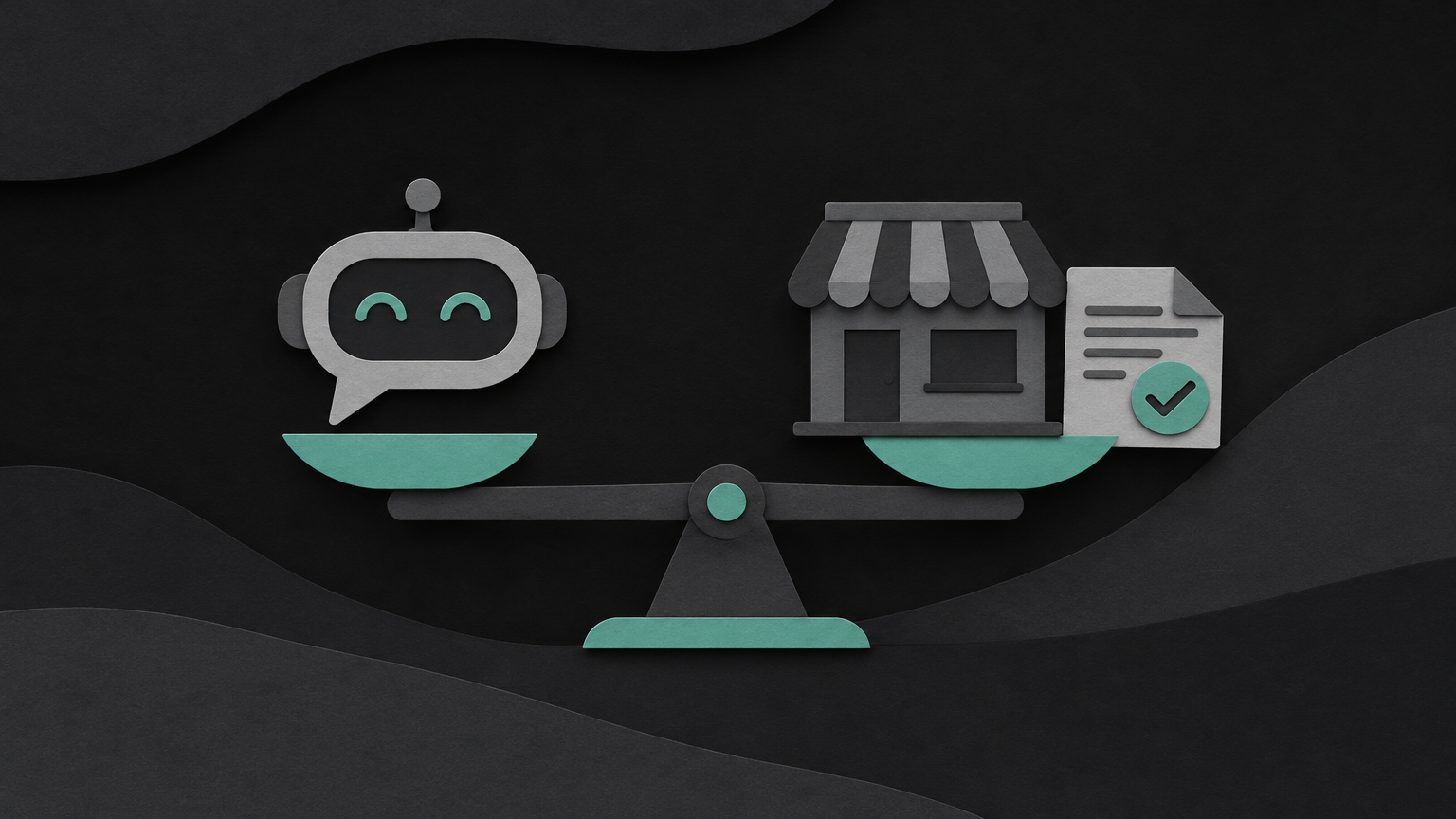
Chatbot liability means your business is responsible for what your chatbot tells customers, the same as any other page on your website.
What happened in the Air Canada chatbot case?
Short answer: a website chatbot described a refund rule that did not exist, a customer relied on it, and a Canadian tribunal ordered the airline to pay.
In Moffatt v. Air Canada, decided by British Columbia's Civil Resolution Tribunal on February 14, 2024, a customer asked the airline's website chatbot about bereavement fares. The chatbot told him the airline offered reduced bereavement fares and that, if he had already travelled, he could submit his ticket for a reduced rate within 90 days of the date the ticket was issued.
The airline's own “Bereavement travel” page, which the chatbot linked to, said the opposite: the policy does not apply to requests made after travel is completed. The customer booked full-price tickets, travelled, applied for the partial refund within the 90 days, and was refused.
The tribunal found the airline liable for negligent misrepresentation and ordered it to pay $650.88 in damages, plus $36.14 in pre-judgment interest and $125 in tribunal fees, for a total of $812.02. The amount is small. The principle is not.
Why was the airline held responsible?
Short answer: the chatbot was part of the airline's website, the airline had a duty to take reasonable care that it was accurate, and the customer reasonably relied on it.
The airline argued that it could not be held liable for information provided by its agents, servants or representatives, including a chatbot. The tribunal called that a remarkable submission and answered it in one line: it should be obvious that the company is responsible for all the information on its website. It made no difference whether the information came from a static page or a chatbot.
Three findings carried the decision:
- A duty of care existed. The airline and its customer had a commercial relationship, so the airline had to take reasonable care that its representations were accurate.
- Reasonable care was not taken. The airline did not show any steps it took to make sure the chatbot was accurate.
- The reliance was reasonable. A customer has no reason to think one part of a company's website is accurate and another part is not, and should not be expected to double-check the chatbot against other pages.
A disclaimer that “AI can make mistakes” moves the responsibility to the customer.
The ruling treated the chatbot as the company's own information. A disclaimer may help set expectations, but it is not a substitute for accurate answers.
Does this apply to your business?
Short answer: the decision is from one Canadian tribunal, but the principle behind it is the one customers, regulators and courts tend to apply everywhere: your channel, your answer.
A small-claims tribunal decision does not bind courts in other provinces or countries, and laws differ between the Philippines, the US, Canada and elsewhere. I am not a lawyer, and you should ask one about your own exposure. What the case shows is how a decision-maker reasons about a chatbot: not as a separate thing with its own responsibility, but as part of the business that deployed it.
That reasoning matters most when your chatbot talks about money, eligibility or obligations: prices, discounts, refunds, warranties, delivery promises, appointment policies, or anything regulated. Those are the answers customers act on.
If you would not let a new hire promise it without checking, your chatbot should not promise it either.
Where do chatbots usually go wrong?
Short answer: when they answer policy questions from memory instead of from one approved source, and when nobody tests the questions that cost money.
The pattern in the Air Canada case is common: the right policy existed and was even linked, but the chatbot's answer did not match it. The risky answers usually fall into a few groups.
| Risk area | What goes wrong | What to do instead |
|---|---|---|
| Refunds and cancellations | The chatbot fills a gap with a plausible rule | Answer only from the published policy, quoted or linked |
| Prices and promos | Old promos stay in the knowledge base | Give every promo an end date and remove it on that date |
| Eligibility | The chatbot decides who qualifies | Collect the facts and let a person confirm |
| Delivery and timelines | It promises dates the team cannot meet | Give ranges from the operations team, never exact promises |
| Regulated advice | Medical, legal, financial or licensed advice slips in | Hand off to a qualified person every time |
How do you protect your business?
Short answer: give the chatbot one approved source for every money-related answer, test those answers before launch and after every change, and keep a person in the loop for anything the source does not cover.
None of this is exotic. It is the same discipline you would apply to a new team member who talks to customers:
- Ground policy answers. Put refunds, cancellations, prices and promos in one knowledge source the chatbot must use, and tell it to quote or link the policy instead of paraphrasing it. My guide on grounding an AI agent in your business knowledge shows how.
- Write guardrails. Tell the chatbot what it must never promise, and what to say instead. See how to stop an AI agent from making things up.
- Hand off the hard questions. Eligibility decisions, exceptions and complaints go to a person. The human handoff guide covers when and how.
- Test the money questions. Build a test set from real customer questions about refunds, prices and promises, and run it before launch and after every change. Use the method in how to test an AI chatbot.
- Keep the transcripts. Review a sample every week, as described in the weekly review. If a wrong answer slips through, you want to find it before a customer quotes it back to you.
A policy change on your website does not update your chatbot by itself unless it reads that page live. Add “update the chatbot's source” to the checklist for every policy or price change.
What can you set up today?
- List the ten questions customers ask that involve money, eligibility or a promise.
- For each one, write down the single page or document that holds the approved answer.
- Ask your chatbot all ten questions and compare each answer with that source, word for word on the numbers and conditions.
- Fix every mismatch in the source the chatbot uses, then add a rule: if the source does not cover it, hand off to a person.
- Put the ten questions in a test sheet and rerun them after every change to prices, policies or the chatbot itself.
How you will know it works (acceptance criteria for the ten money questions):
| Check | Pass when |
|---|---|
| Accuracy | 10 of 10 answers match the approved source on numbers, dates and conditions |
| Linking | Every policy answer links or quotes the policy page |
| Uncovered questions | Questions outside the source go to a person instead of a guess |
| Change control | The test set is rerun and passes after every policy, price or chatbot change |
| Review | A weekly sample of transcripts is read, and any wrong promise is fixed the same week |
An honest limitation: these steps lower the risk of a wrong answer, but no setup makes an AI chatbot perfect, and they do not replace legal advice about your obligations where you operate.
Frequently asked questions
Is a business legally responsible for what its chatbot says?
In Moffatt v. Air Canada (2024), a Canadian tribunal held the airline responsible for its website chatbot's wrong answer, treating it like any other information on the website. Laws differ by country, so ask a lawyer about your situation, but plan as if your chatbot speaks for you.
How much did Air Canada have to pay?
$812.02 in total: $650.88 in damages, $36.14 in pre-judgment interest and $125 in tribunal fees. The amount was small; the attention the case received was not.
Does an “AI can make mistakes” disclaimer protect my business?
Do not rely on it. The tribunal found a customer should not have to double-check one part of a website against another. Accurate, grounded answers protect you far better than a disclaimer.
Should my chatbot stop answering policy questions?
No. Customers want fast answers about refunds, prices and bookings. Let it answer from one approved source, link the policy, and hand off anything the source does not cover.
Make sure your chatbot says only what you would say
Want a second pair of eyes on what your chatbot promises customers? Book a free AI Automation Blueprint call and we will map your riskiest answers and how to ground them.
Prefer to learn it step by step? Join the free weekly newsletter.
References
- Moffatt v. Air Canada, 2024 BCCRT 149, Civil Resolution Tribunal of British Columbia, February 14, 2024 (paragraphs 15, 17, 24 to 27, 31 to 32 and 40 to 44).
- Barry B. Sookman, McCarthy Tétrault TechLex: Moffatt v. Air Canada: A Misrepresentation by an AI Chatbot, February 19, 2024.
Keep reading
Get one practical idea like this every week
Join the free newsletter on AI agents, automation and turning your skills into income. Prefer video? Watch the walkthroughs on YouTube.
Want a system like this built for your business? Book a free AI Automation Blueprint call, or see the done-for-you services at my consultancy, IRD Digital Marketing Services.
DIJAE DADULA
Dijae Dadula · AI automation and systems specialist · Cavite, Philippines · Founder of IRD Digital Marketing Services
Home · Blog · Book a call · Newsletter · YouTube · Threads · Transparency
Some links on this site are affiliate links. If you buy through them, I may earn a commission at no extra cost to you.
© 2026 Dijae Dadula. All rights reserved.
